


Description
Solerion, the solar recharging system
Once the photovoltaic panels (PV) have been installed at the operating site, the Solerion makes use of the solar energy converted by the PV panels, thanks to the MPPT* load regulator for optimum recharge of the connected battery.
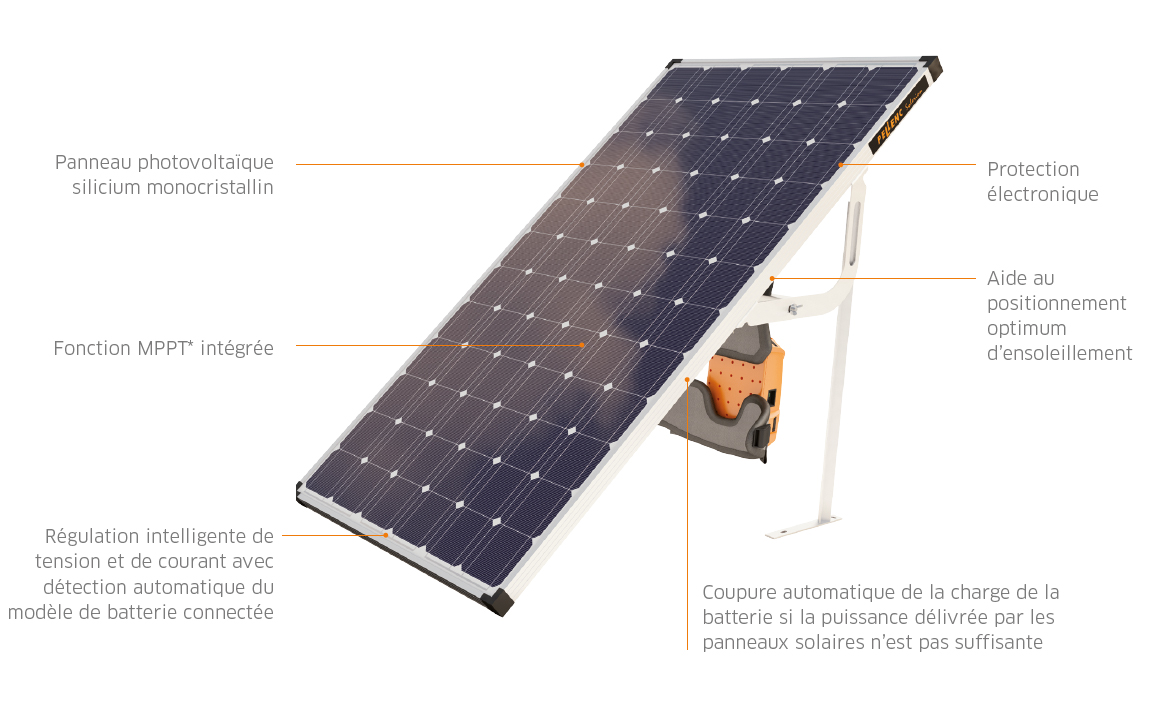
* MPPT (Maximum Power Point Tracking): This function allows the optimum power drawn to be permanently tracked so that the photovoltaic panels can be subsequently supplied with the maximum peak power.
| SOLERION | |
|---|---|
| Max. power (at 1000 W/m²) – W | 280 |
| Charging voltage – V | 50,2 |
| Max. charging current at 1000 W/m² (Excellent insolation) – A | 5,2 |
| Max. charging current at 600 W/m² (Average insolation) – A | 2,9 |
| Stop charge current – mA | 200 |
| System dimensions (L x l x H) – mm | 1950 x 995 x 500 |
| Weight – kg | 32 |
Standard and quick chargers
Intelligent charge system that optimises the service life. Batteries enter a discharge cycle after 10 days of non-use, for optimal storage for 24 months. You just need to remember to store the batteries fully charged. PELLENC lithium-ion batteries do not suffer from memory run-down.
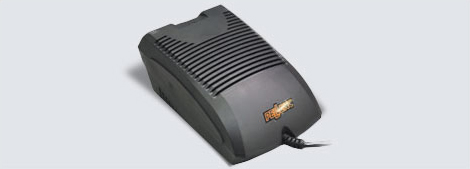
Standard chargers 1.2 A – 2.2 A
Once the battery is completely discharged, the tool stops automatically and the battery buzzer beeps intermittently. The standard charger, supplied with the battery (1.2 A charger for 200, 400 and Poly 5 batteries and 2.2 A charger for 700 and 1100 batteries) can then recharge your battery over a variable period. The charge time depends on the battery level, the charging environment (dry and ventilated area, protected from dust and with a temperature of between 10°C and 25°C) and the age of your battery. The standard charger is delivered with the battery and harness. Before using the battery for the first time at the start of a new season, it must be fully charged (99 % steady capacity).
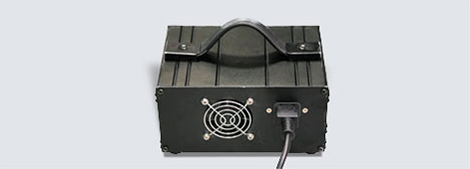
“Quick charger”
The quick charger will help boost battery charging. For improved durability of the batteries, PELLENC strongly recommends performing a conventional charge (with the standard charger) after every five quick charges. With the rapid charger, the charging time of the 700 and 1100 batteries is reduced by an average of 3-4 hours, keeping in mind that after 1.5 hours to 2 hours, the capacity has already reached 70 %.
The Quick Charger is available as an option.
Charger and battery charge time
| CHARGERS* | 400 | 700 | 1100 | POLY 5 |
|---|---|---|---|---|
| 1.2 A standard charger | 9h | 15h | 22h | 9h |
| 2.2 A standard charger | 5h | 8h | 12h | 5h |
| Quick Charger | 1 h 30 min (starting in 2016) |
3h | 4h | 2h |
| SOLERION: with low insolation | 4h | 6h40 | 11h | 5h |
| SOLERION: with normal insolation | 3h | 3h30 | 5h | 2h40 |
*Charging time calculated in optimal conditions. Refer to the battery instructions for conditions.
Power Convertor 1000
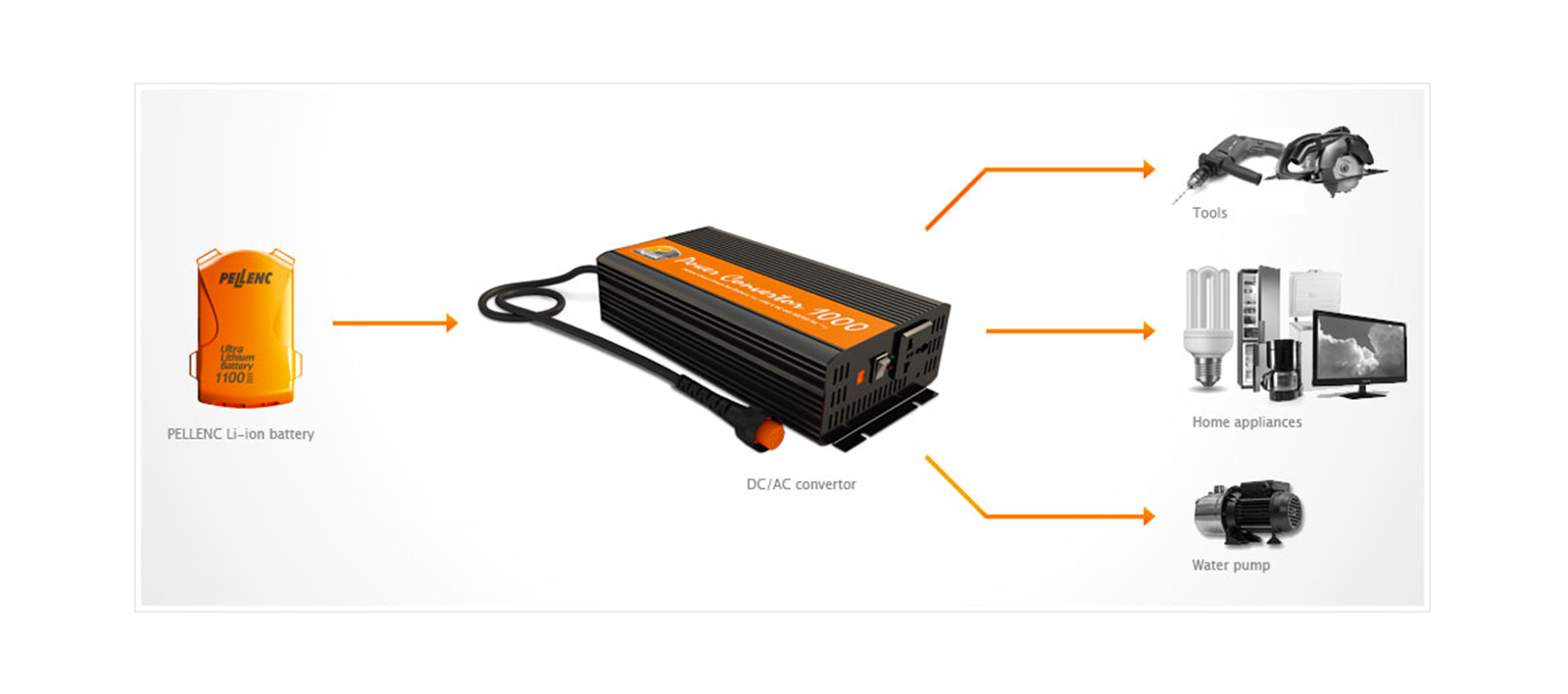
The converter that transforms the battery voltage to 230 Vac.
Combined with a PELLENC battery, the POWER CONVERTOR 1000 is the solution for storing and using electrical energy. Thanks to this product, all electrical appliances below 1000 W can operate autonomously: domestic appliances, drills, jackhammers, etc… The output voltage is pure sine wave (as on any electrical distribution network) to enable asynchronous motor control.
| SINE WAVE POWER CONVERTOR 1000 | |
|---|---|
| Rated power – W | 1000 |
| Rated power over 1 second – W | 2000 |
| Input voltage (Pellenc battery) – Vd | 36 – 52 |
| Maximum input voltage – A | 55 |
| Pure sine wave output voltage – Vac +/- 5 % | 230 |
| Output current to 1000 W maximum – A | 4,5 |
| Switchable output frequency – Hz | 50/60 |
| Protection rating | IP20 |
| Weight – Kg | 2,7 |
| Battery compatibility | ULIB 700, ULIB 1100, Poly 5 |
Caution : do not connect the Power Convertor 1000 to an electrical distribution network.
*Specifications are correct at time of print and are subject to change without notice.